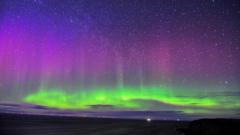
Your eyes are lying to you.
Every time you scroll through a "stunning" gallery of the Northern Lights, you are looking at a mathematical lie processed by a CMOS sensor. The viral photos showing neon pinks and electric greens are not what the human eye perceives. They are long-exposure fabrications. Recently making news in this space: The Night the Nursery Walls Dissolved.
We are currently approaching the solar maximum, the peak of Solar Cycle 25. The media is desperate to sell you on "once-in-a-lifetime" sightings. They want you to book the $5,000 flight to Tromsø or Fairbanks. But here is the reality of the industry: most tourists spend three nights shivering in a frozen field only to see a faint, grey smudge that looks more like a high-altitude cloud than a celestial disco.
If you want the truth about the Aurora Borealis, you have to stop looking at Instagram and start looking at the biology of the human retina. More insights regarding the matter are detailed by Lonely Planet.
The Scotopic Vision Trap
The most common misconception about the Northern Lights is that they actually look like the photos. They don't.
Human vision is divided into two primary modes: photopic (daytime, color-sensitive) and scotopic (low-light, monochrome). The cells in your eyes that detect color—the cones—require a significant amount of light to activate. The cells that function in the dark—the rods—are incredibly sensitive but almost entirely color-blind.
When an aurora is at a "moderate" level, it sits right in the gap between these two modes. Your rods see the movement, but your cones aren't receiving enough photons to register the green or red hues. To the naked eye, a standard aurora often appears as a ghostly, whitish-grey veil.
Digital cameras do not have this limitation. A modern mirrorless camera can hold its "eye" open for 15 seconds, drinking in every stray photon of 557.7 nm oxygen emission. It stacks that light, saturates it, and spits out a vibrant emerald image. When you arrive in Iceland expecting that neon glow, you aren't just fighting the weather; you’re fighting your own evolution.
Solar Maximum is a Marketing Gimmick
The travel industry is currently obsessed with the solar maximum. They argue that increased sunspot activity and Coronal Mass Ejections (CMEs) guarantee a better show.
Mathematically, they are right. From a traveler's perspective, they are mostly wrong.
While the solar maximum increases the frequency of geomagnetic storms, it does nothing to solve the three Horsemen of Aurora Failure:
- Cloud Cover: Statistics show that many high-latitude regions see increased cloudiness during the winter months when the nights are longest. You can have a Level 7 G-scale storm happening, but if there’s a thick layer of stratus, you’re looking at a grey ceiling.
- The Moon: Travelers forget that a full moon washes out the aurora more effectively than light pollution from a small city.
- The Kp-Index Fallacy: People obsess over the Kp-index, a scale from 0 to 9. They think a Kp 5 is "good" and a Kp 2 is "bad." In reality, a Kp 2 aurora directly overhead in a dark sky is infinitely more impressive than a Kp 7 storm viewed from a lit-up parking lot or through a hazy horizon.
I have seen travelers spend ten thousand dollars on "Arctic Glamping" pods during a solar peak, only to sit inside a heated bubble staring at a blizzard for 72 hours. The sun doesn't care about your itinerary.
The Hidden Cost of Light Pollution
We talk about light pollution in cities, but we don't talk about the "Aurora Tourism" light pollution.
Go to any popular "dark sky" spot in Norway or Finnish Lapland. You will find forty rental vans with their engines running to keep the heaters on. You will find two hundred people with iPhones, their screens set to maximum brightness, destroying everyone’s night vision.
It takes roughly 20 to 30 minutes for your eyes to fully dark-adapt. Every time someone opens a car door or checks a text message, that timer resets. You are literally paying to be blinded by other people’s desperation to document their "authentic" experience.
Stop Chasing the Green Ghost
If you actually want to see the lights—and I mean see them, not just photograph them—you need to stop following the crowd.
1. Ignore the "Peak" Years
The best auroras often happen on the declining side of the solar cycle. High-speed solar wind streams from coronal holes are more stable and predictable than the erratic CMEs of the solar maximum. If you wait until 2027 or 2028, the crowds will have thinned, the prices will have dropped, and the lights will be just as frequent, if not more reliable.
2. Prioritize Micro-Climates over Latitudes
Don't just go "North." Go to the rain shadow. Places like Abisko in Sweden are famous for a "blue hole"—a specific geographical quirk where the surrounding mountains suck the moisture out of the air, leaving a clear patch of sky even when the rest of the Arctic is socked in. Geography beats latitude every single time.
3. Learn to Use an All-Sky Map
Stop using "Aurora Alert" apps that give you a percentage chance based on your GPS. They are notoriously laggy. Instead, learn to read real-time magnetometers and hemispheric power maps. If the "oval" is dipping toward you and the Bz component of the Interplanetary Magnetic Field (IMF) is pointing south (negative), get outside. If the Bz is pointing north, go back to sleep. It doesn't matter how high the Kp-index is; if the IMF isn't "hooking up" with Earth’s magnetic field, the lights aren't happening.
The Brutal Truth of the Arctic
The travel industry sells the Northern Lights as a spiritual, silent communion with nature.
The reality is usually standing in -20°C wind, losing feeling in your toes, and smelling diesel fumes from a tour bus while a tripod leg pokes you in the ribs. The "stunning colors" you see in the news are a byproduct of post-processing and long-exposure sensors.
If you go, go for the tundra. Go for the silence. Go for the dogsledding or the culture. Treat the aurora as a 5% bonus that probably won't happen.
If you go specifically for the lights, you are gambling against physics, biology, and meteorology with the house always winning. Most people return with a gallery of blurry green squares on their phone and a deep sense of FOMO they are too embarrassed to admit.
Stop buying the hype. The sun is a chaotic nuclear furnace, not a scheduled light show for your vacation.
Put the camera down. Turn off the phone. If the lights do show up, let them be a grey, flickering ghost in the corner of your eye. That is the only version of the Northern Lights that is actually real. Everything else is just a filter.
Buy a better coat and stop looking at the Kp-index. If it happens, it happens. If it doesn't, at least you weren't staring at a screen the whole time.


