The air in Terminal C at Newark Liberty is usually thick with the smell of burnt coffee and the frantic energy of people who are already late. But this Monday morning, the atmosphere was different. It was heavy. Static.
A four-man patrol moved through the crowd. They didn't walk like the TSA agents we’ve grown used to—the ones who bark about laptops and liquids with a weary, practiced boredom. These men walked with a rigid, military precision. They wore black tactical vests. The letters across their backs didn't say "Security." They said ICE.
For thirty-nine days, the federal government has been eating itself. A partial shutdown over immigration policy has left nearly 50,000 TSA officers working for the promise of a paycheck that hasn't arrived in weeks. They are tired. They are calling out sick. Hundreds have simply quit, leaving their blue uniforms in lockers and walking away from a mission that no longer pays the rent.
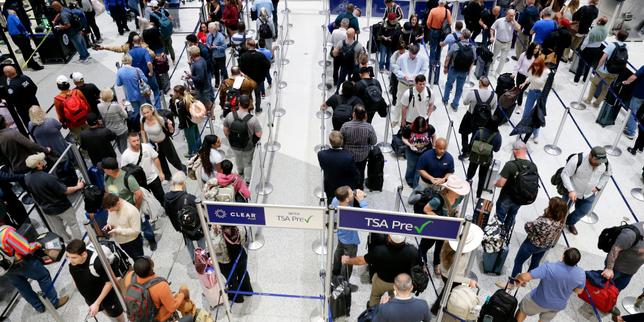
The result is a landscape of human frustration. At Hartsfield-Jackson in Atlanta, the world's busiest airport, the wait-time trackers have been replaced by a grim warning: Arrive four hours early. In Houston, the lines at George Bush Intercontinental have snaked out of the terminal and into the subway stations.
Now, the government’s solution to the shortage of blue vests is a surge of black jackets.
The Invisible Line
Consider a hypothetical traveler named Elena. She is flying from Phoenix to New Orleans to see her mother. She has lived in the U.S. for twenty years. She is documented. She is "legal." Yet, as she approaches the stanchions at Sky Harbor and sees a side-armed Immigration and Customs Enforcement agent guarding the exit lane, her heart rate spikes.
It isn't a matter of guilt. It’s a matter of the "shock and awe" that Border Czar Tom Homan once promised.
The administration insists these agents are "force multipliers." They are there to do the "non-significant" roles—guarding exits, directing traffic, checking IDs—to free up the remaining TSA staff for the X-ray machines. They aren't supposed to be making immigration arrests. Not officially. But the President’s own words on social media have blurred that line, suggesting that airports are "fertile ground" and that agents should place a "heavy emphasis" on certain nationalities.
This is where the math of security meets the messy reality of human fear.
Standard aviation security is a clinical process. It’s about finding metal, liquids, and lithium batteries. It’s a science of detection. But when you introduce ICE—a force trained for raids, detention, and enforcement—the air in the terminal changes. The passenger who was already stressed by a three-hour wait is now wondering if their seatmate will be led away before they board.
The invisible stakes are the trust that makes a public space feel safe.
The Missing Experts
There is a technical gap that no amount of political rhetoric can fill. Aviation security is a specialized field. It isn't just about a uniform and a badge. It’s about months of classroom training, specialized instruction, and on-the-job practice.
The TSA officers who have stayed are the ones we rely on to find explosives specifically designed to evade detection. They are the experts in the physics of a threat.
But the ICE agents, however patriotic their intent, are not trained for the X-ray machine. They aren't certified for the pat-down or the bag search. When they take over the "support" roles, they are effectively holding the line without the same tools.
Consider the 14 airports where they've been spotted:
- Hartsfield-Jackson Atlanta (ATL)
- Newark Liberty (EWR)
- John F. Kennedy (JFK)
- LaGuardia (LGA)
- George Bush Intercontinental (IAH)
- William P. Hobby (HOU)
- New Orleans Louis Armstrong (MSY)
- Phoenix Sky Harbor (PHX)
- Chicago O’Hare (ORD)
- Philadelphia (PHL)
- Pittsburgh (PIT)
These are the nodes of the American transport system, and they are now the front lines of a political standoff. In Phoenix, travelers were "pleasantly surprised" by the speed of the lines, but apprehensive about the presence of the agents. The speed was the carrot. The black vest was the stick.
The True Cost
The real problem lies in the disconnect.
We are told this is a solution to a "mess" caused by a funding deadlock. We are told the TSA is being "helped." But the people in the blue vests—the ones who haven't been paid for forty days—aren't asking for more armed agents at the exits. They are asking to be paid.
The government is shifting resources within the Department of Homeland Security, using money that Congress allocated for ICE last summer to pay for a mission that is fundamentally different. It is a shell game with the nation’s security.
When you walk through Terminal C today, you will see a man in a black vest and a sidearm. He will be watching you as you walk past. He might be there to help. He might be there to ensure you don't go through an exit you shouldn't.
But as the flight attendants’ unions have pointed out, the very presence of these agents can be a distraction. When a traveler is questioning their own safety, or the status of their neighbor, they aren't looking for the real threats. They are looking at the agents.
The government has chosen "shock and awe" over the quiet, professional competence of a paid security force.
It is a high-stakes experiment in what makes us feel safe. Is it the presence of a weapon and a badge? Or is it the knowledge that the person checking your bag is a professional who can afford to buy their own groceries?
The lines at Newark are moving, for now. The agents are strolling down Terminal C, their vests a stark contrast to the colorful luggage and the tired travelers. They are silent, declining to answer questions. They are a presence, but they are not a fix.
The real fix is in a building in Washington, D.C., where the people who can actually pay the TSA are still arguing over a budget.
Until then, we are left with the blue vests and the black jackets, and the heavy, static air of a terminal that has forgotten what it means to be a place of departure, and has instead become a place of enforcement.
The flight to New Orleans is boarding. Elena picks up her bag and walks toward the gate. She doesn't look back at the man in the black vest. She doesn't have to. She can feel him watching her.
Would you like me to research the current wait times at any of the affected airports for your upcoming travel?