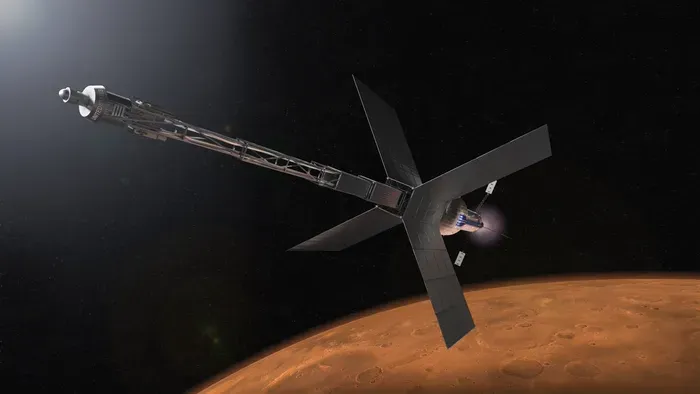
Chemical rockets have reached the asymptotic limit of their performance, dictated by the energy density of molecular bonds. To move beyond the Moon and establish a sustainable presence on Mars, NASA is shifting from chemical combustion to Nuclear Thermal Propulsion (NTP). This transition is not merely a hardware upgrade; it is a fundamental shift in the mass-fraction equation of interplanetary travel. By utilizing a nuclear reactor to heat a propellant—typically liquid hydrogen—to extreme temperatures, NTP systems double the specific impulse ($I_{sp}$) of the most efficient chemical engines. This allows for significantly reduced transit times, lower radiation exposure for crews, and an increased payload capacity that transforms a "flags and footprints" mission into a viable logistical pipeline.
The Specific Impulse Bottleneck
The primary metric of rocket efficiency is specific impulse ($I_{sp}$), measured in seconds. It represents the thrust produced per unit of propellant flow rate. Modern oxygen-hydrogen chemical engines, like the RS-25, peak at approximately 450 seconds. This limitation is physical: the energy released comes from the breaking and forming of chemical bonds, which is capped by the enthalpy of reaction.
NTP bypasses this chemical ceiling. In an NTP system, a compact fission reactor generates thermal energy, which is then transferred to a cold propellant. Because the propellant does not need to be an oxidizer-fuel mix, engineers can use liquid hydrogen ($LH_2$), the lightest possible molecule. The velocity of exhaust gases is inversely proportional to the square root of the molecular weight of the propellant. By using pure hydrogen instead of the heavier water vapor produced by chemical combustion, NTP can achieve an $I_{sp}$ of 850 to 900 seconds.
This 100% increase in efficiency radically alters the Initial Mass in Low Earth Orbit (IMLEO). For a crewed Mars mission, a chemical architecture requires massive propellant depots and multiple heavy-lift launches just to assemble the transit vehicle. An NTP architecture cuts the required propellant mass by half or more, enabling a more streamlined launch manifest.
Thermal Management and Reactor Geometry
The engineering challenge of NTP lies in the heat transfer coefficient between the reactor core and the propellant. To achieve high $I_{sp}$, the propellant must reach temperatures exceeding 2,500 Kelvin. This requires fuel elements capable of maintaining structural integrity near their melting points while being subjected to intense radiation and high-pressure hydrogen flow, which can cause "hydrogen corrosion" in carbon-based fuel elements.
- Fuel Element Composition: Modern designs focus on High-Assay Low-Enriched Uranium (HALEU) encapsulated in ceramic-metallic (cermet) or zirconium carbide matrices. These materials offer the thermal conductivity required to move Megawatts of heat from the fissioning atoms to the hydrogen gas in milliseconds.
- The Heat Exchange Surface: The reactor core must be honeycombed with narrow channels. The goal is to maximize the surface area-to-volume ratio to ensure the hydrogen reaches the maximum possible temperature before exiting the nozzle.
- Neutronic Control: Unlike terrestrial power plants, an NTP reactor must go from "cold" to full power in seconds and shut down just as quickly. This requires high-speed control drums—cylinders with one side coated in a neutron absorber like boron carbide—that rotate to regulate the fission rate.
Logistics of the Mars Transit Window
The orbital mechanics of a Mars mission are traditionally governed by the Hohmann Transfer Orbit, the most energy-efficient path. However, this path is slow, requiring roughly 250 to 300 days of travel one way. Long-duration spaceflight introduces two primary risks: cumulative galactic cosmic radiation (GCR) dose and physiological degradation due to microgravity (bone density loss and muscular atrophy).
NTP enables "High-Energy Missions." By utilizing its superior $I_{sp}$, an NTP ship can burn its engines longer or harder, exiting Earth's gravity well at higher velocities. This reduces the transit time to approximately 100 to 120 days. The reduction in mission duration is the single most effective radiation shielding strategy available; by spending 50% less time in deep space, the crew's total mission dose remains within acceptable career limits without the need for heavy lead or water shielding that would otherwise penalize the mass budget.
The Hydrogen Storage Paradox
While $LH_2$ is the ideal propellant for efficiency, it is a logistical nightmare for long-duration storage. Hydrogen is the smallest molecule and prone to leaking through the atomic lattice of storage tanks. Furthermore, it must be kept at cryogenic temperatures (below 20 Kelvin).
The "Boil-Off" problem creates a ticking clock. In a chemical mission, if the propellant boils off, the mission fails. NTP systems must integrate "Zero Boil-Off" (ZBO) technology, utilizing active cryocoolers powered by the reactor’s secondary power-generation mode (bimodal operation). A bimodal NTP system uses the reactor to generate thrust during burns and low-level electrical power during the cruise phase, maintaining the integrity of its own fuel supply.
Critical Failure Modes and Risk Mitigation
Transitioning to nuclear propulsion introduces risks that differ from traditional chemical explosions.
- Launch Abort Scenarios: The reactor is not turned on until the spacecraft has reached a "nuclear-safe" orbit (typically 700km or higher). This ensures that even in the event of a launch vehicle failure, the radioactive material remains in a sub-critical, cold state, and any debris would remain in orbit for centuries, allowing the radioactivity to decay before re-entry.
- Core Meltdown: If propellant flow is interrupted while the reactor is at full power, the residual decay heat can melt the core. Engineers address this through redundant flow paths and "decay heat removal" systems that bleed small amounts of hydrogen through the core for hours after shutdown.
- Radiation Leakage: While the reactor is shielded to protect the crew (shadow shielding), the propellant itself acts as a shield. The hydrogen tanks are positioned between the reactor and the crew habitat, utilizing the fuel's mass to absorb neutrons and gamma rays.
The Strategic Pivot to In-Situ Resource Utilization (ISRU)
The ultimate value of NTP is its compatibility with In-Situ Resource Utilization. Mars has vast deposits of water ice. If a colony can harvest this ice and electrolyze it into hydrogen, an NTP spacecraft becomes a "refillable" bus. Chemical rockets require both fuel and a heavy oxidizer; NTP only requires the fuel. This simplifies the chemistry required for Martian propellant production by an order of magnitude.
The deployment of a nuclear-powered spacecraft marks the end of the "disposable" era of space exploration. It necessitates the construction of orbital hubs where these high-value engines can be docked, refueled, and reused for multiple transits. The focus shifts from the cost per launch to the cost per ton of cargo delivered to the Martian surface.
Execution Framework for Interplanetary Logistics
To operationalize this technology, the mission architecture must prioritize the following sequence:
- HALEU Supply Chain Stabilization: Establish a consistent production of 19.75% enriched uranium to fuel the first generation of flight-weight reactors.
- Cryogenic Fluid Management (CFM) Validation: Demonstrate long-term $LH_2$ storage in Low Earth Orbit to prove that a Mars-bound ship won't lose its propellant before it even leaves the Earth-Moon system.
- Bimodal Integration: Perfect the transition between high-thrust thermal mode and low-power electrical mode to ensure the reactor provides life support and communications during the four-month cruise.
The shift to nuclear thermal propulsion is a recognition that chemical energy is insufficient for a multi-planetary species. The focus now moves to the metallurgical limits of reactor cores and the thermodynamic efficiency of cryogenic storage. Establishing these nuclear-enabled "fast-transit" corridors is the only viable path to making Mars a functional outpost of the human economy.
Would you like me to analyze the specific mass-to-orbit requirements for a bimodal NTP Mars mission compared to a Methalox-based SpaceX Starship architecture?