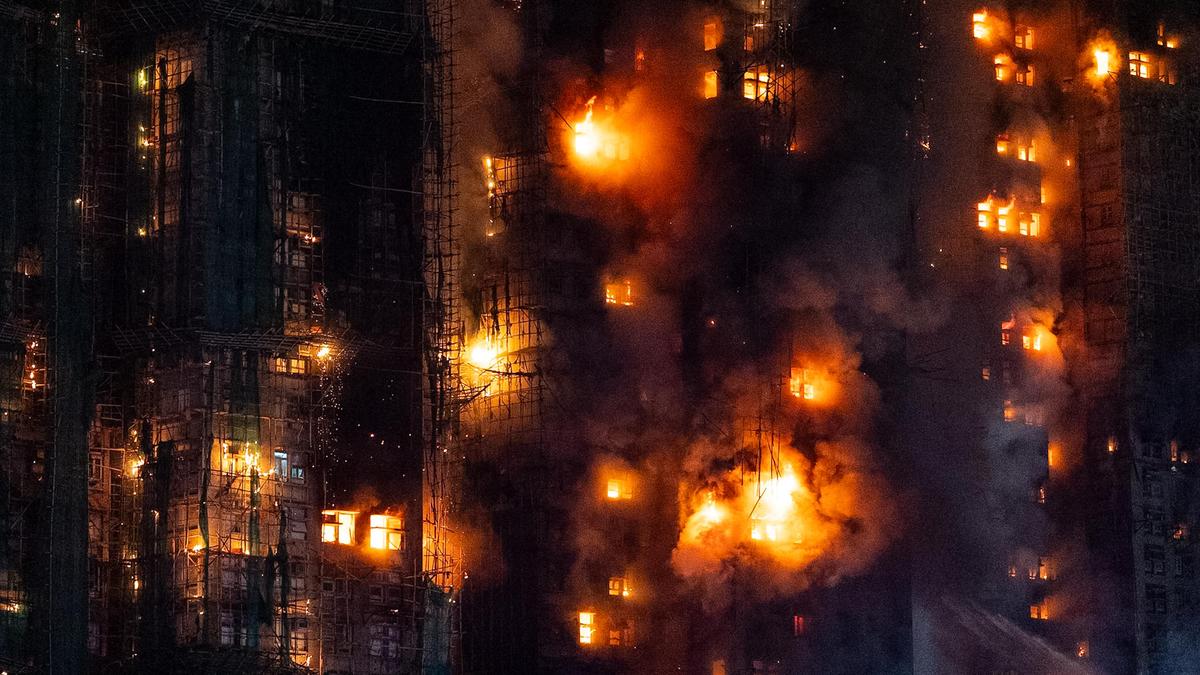
The fatalities recorded at New Lucky House in Jordan, Hong Kong, represent a predictable failure of systemic oversight rather than an isolated accident. When a fire in a high-density, mixed-use building results in five deaths and dozens of injuries, the inquiry must move beyond identifying the ignition source to mapping the failure of the building’s "Passive and Active Fire Protection" (PFP/AFP) systems. This analysis deconstructs the structural and regulatory bottlenecks that turned a localized fire into a mass-casualty event, focusing on the breakdown of the Fire Safety (Buildings) Ordinance and the lethality of "smoke-logging" in unmanaged common areas.
The Triad of Systematic Failure in Older High-Rise Stock
The New Lucky House incident serves as a case study for three specific categories of failure that characterize Hong Kong’s aging residential-commercial intersections.
1. The Breakdown of the Compartmentation Strategy
High-rise safety relies on "compartmentation"—the ability of a building to contain a fire within its room of origin for a specified period (typically 60 to 120 minutes). In the case of New Lucky House, this strategy failed due to unauthorized structural alterations. When subdivided flats (tong lau) are created, the original fire-rated walls are often breached to accommodate new plumbing and electrical lines. These gaps act as thermal bridges and smoke conduits. If the fire-rated doors in common corridors are propped open or replaced with non-compliant materials, the entire floor’s compartmentation is neutralized.
2. The Chimney Effect in Vertical Egress
The primary cause of death in such fires is rarely thermal trauma but rather the inhalation of toxic gases (carbon monoxide and hydrogen cyanide). In New Lucky House, the internal stairwells—intended as "protected lobbies"—functioned as chimneys. This occurs when the "Stack Effect" is triggered: the temperature differential between the fire floor and the external environment creates a pressure gap that sucks smoke into the vertical shafts. If smoke-stop doors fail to close automatically, the evacuation route becomes the most dangerous part of the building.
3. The Compliance Gap in Fire Safety Directions
A critical data point in this inquiry is the status of the Fire Safety Directions issued by the Fire Services Department (FSD) and the Buildings Department (BD). Reports indicate that the building had unfulfilled safety directions dating back several years. This highlights a "regulatory lag" where the cost of compliance for a fragmented Owners' Corporation (OC) exceeds the perceived risk of non-compliance. The economic friction of coordinating dozens of individual owners to fund multi-million dollar fire-system upgrades creates a permanent state of high-risk inertia.
Quantifying the Lethality of Smoke-Logging
The evidence hearings focus heavily on the first 15 minutes of the blaze. In high-density environments, the "Available Safe Egress Time" (ASET) must exceed the "Required Safe Egress Time" (RSET).
$ASET > RSET$
At New Lucky House, the RSET was artificially inflated by several factors:
- Obstructions in Means of Escape (MOE): Stored furniture and waste in corridors reduce the "effective width" of the exit route, slowing down the flow of occupants.
- Acoustic and Visual Isolation: Subdivided units often lack interconnected fire alarm systems. Residents in one "sub-unit" may be unaware of a fire in the adjacent sub-unit until smoke has already compromised the common corridor.
- The Guest House Paradox: The presence of licensed and unlicensed guest houses introduces a population unfamiliar with the building’s layout. Unlike permanent residents, transient occupants lack the "spatial memory" required to navigate a smoke-filled environment, leading to "milling behavior" and fatal delays in decision-making.
The Cost Function of Maintenance Neglect
The inquiry must address why the "Active Fire Protection" (AFP) systems—sprinklers, fire hydrants, and hose reels—frequently fail in these buildings. The failure is rarely mechanical; it is financial and administrative.
The maintenance of a Fire Service Installation (FSI) requires an annual inspection (FS251). However, a "valid" certificate does not guarantee a "functional" system if the underlying water tank is empty or if the booster pumps have been deactivated to prevent leaks from damaging units. In New Lucky House, the investigation into whether the fire hydrants provided adequate pressure at the moment of engagement will determine if the building's internal defense was offline.
The "Cost of Failure" in this context includes:
- Direct Loss: Structural damage and life-safety impact.
- Indirect Loss: Business interruption for the ground-floor commercial tenants.
- Regulatory Penalty: Potential criminal liability for the Owners' Corporation if "willful negligence" is proven regarding the Fire Safety Directions.
Structural Vulnerability of Mixed-Use Zoning
New Lucky House is not purely residential; its "mixed-use" status (commercial/residential) increases the "Fire Load Density." Commercial units, particularly those involving kitchens or storage of combustible retail goods, have a higher probability of ignition than standard residential units.
When a high-load commercial fire occurs on a lower floor, the entire residential population above is placed at risk due to vertical fire spread. The inquiry’s focus on the "point of origin"—suspected to be near the lower-floor gym or guest house areas—is vital because it dictates whether the fire spread through internal voids (pipes and ducts) or externally through "cladding/window jump" (vertical flame spread on the building exterior).
The Strategic Path Toward Mitigation
The findings from the New Lucky House probe must trigger a shift from reactive inspections to a risk-based "Categorization Model" for all buildings over 50 years old.
The first move is the mandatory centralisation of Fire Safety Direction funding. The current model, which relies on individual Owners' Corporations to source contractors and manage funds, is broken. A "Public-Private Partnership" (PPP) model, where the government front-loads the cost of fire-rated door replacements and stairwell pressurization systems, with costs recovered through land-premium adjustments or property tax surcharges, would bypass the administrative gridlock of subdivided ownership.
The second move involves the integration of "Smart Building" sensors. In buildings where structural upgrades are delayed, the installation of wirelessly networked smoke detectors (not requiring expensive rewiring) can provide the crucial 120-second early warning needed to clear a floor before smoke-logging occurs.
Finally, the Buildings Department must move toward "Digital Twin" modeling for older stock. By digitizing the floor plans of buildings like New Lucky House, the Fire Services Department can simulate fire spread patterns and evacuation bottlenecks before an incident occurs. This allows for the tactical positioning of fire-fighting assets and more informed "Stay Put" vs. "Evacuate" instructions during an active blaze.
The inquiry will likely conclude that a combination of unsealed service penetrations, non-compliant exit doors, and delayed system maintenance created a "Perfect Storm." The resolution is not found in more inspections, but in the forced modernization of the structural hardware that governs smoke movement. Without a mandated, state-funded overhaul of the internal compartmentation of these buildings, the regulatory gap will continue to be filled by preventable fatalities.