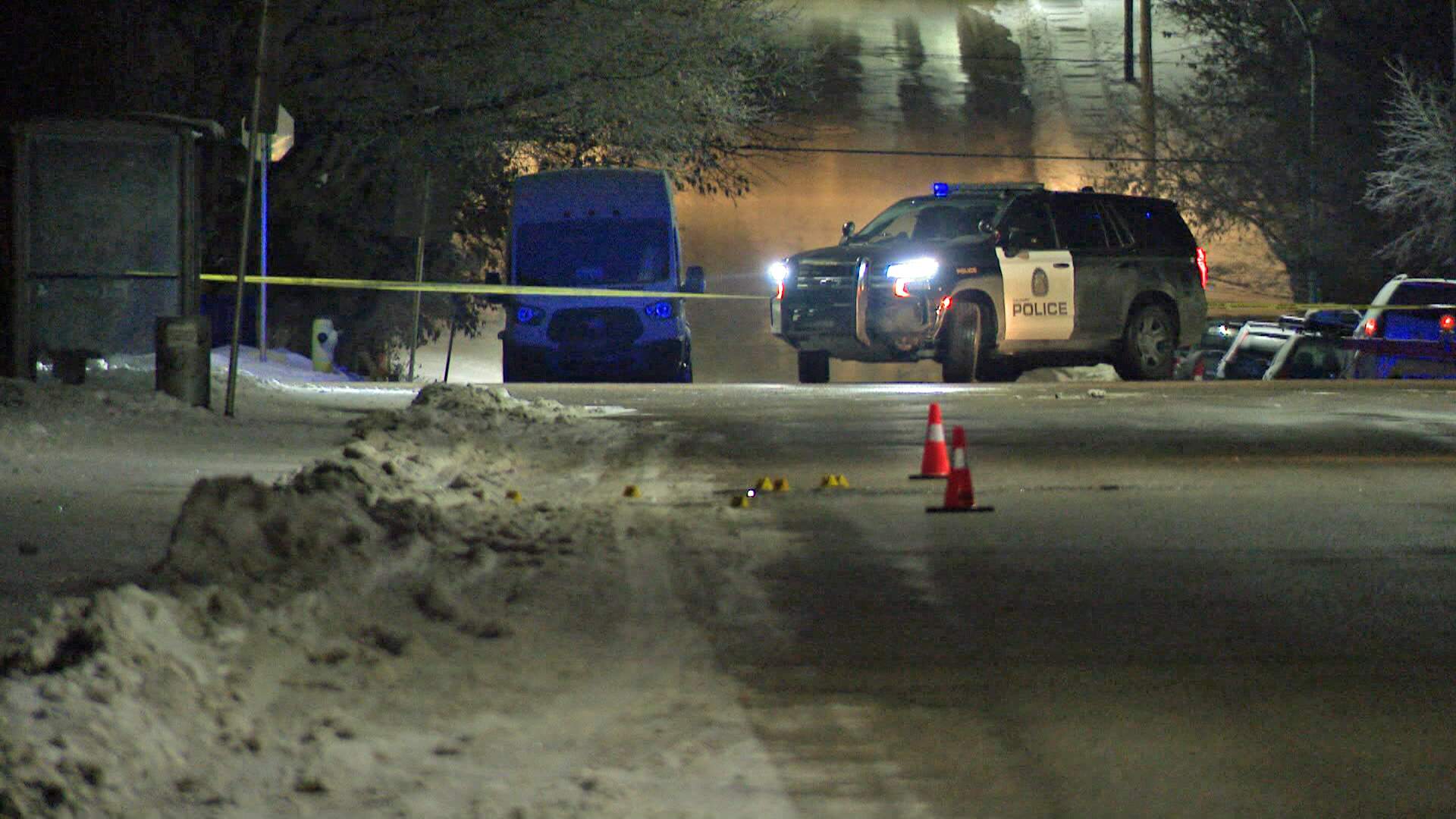
The air in Calgary during the first week of the month wasn't just cold; it was heavy. It was the kind of atmospheric pressure that precedes a rupture. On a nondescript stretch of asphalt, the mundane rhythm of a city was shattered by the sharp, metallic finality of a life ending. When the echoes of the sirens faded, a man lay dead. The statistics will tell you he was a victim of a homicide. The police reports will label him a file number. But for those left behind, he was a void—a sudden, jagged hole in the fabric of a family.
Justice, in its initial stages, is rarely a sprint. It is a slow, methodical grind of forensics, digital breadcrumbs, and the patient waiting that defines a manhunt. For days, the suspects were ghosts. They were names whispered in precinct hallways and faces flickering on grainy CCTV footage. They had fled the scene, perhaps believing that the vast, rugged expanse of the Canadian West could swallow them whole.
They were wrong.
The Trans-Canada Highway is a ribbon of concrete that promises freedom, but it is also a funnel. As the two men, aged 24 and 28, sped toward the jagged peaks of the Rockies and across the provincial line into British Columbia, they weren't just driving away from a crime. They were driving into a net that had been quietly tightening since the moment the first 911 call was placed.
The Geography of an Arrest
Think of the border between Alberta and British Columbia not as a line on a map, but as a pressure sensor. When a high-profile violent crime occurs in Calgary, the information doesn't just sit in a local database. It radiates. It flows through the radio waves to the RCMP detachments in the mountain passes and the quiet coastal towns.
In the small community of Revelstoke, where the mountains seem to lean in over the road, the air is usually silent save for the hum of long-haul truckers. That silence broke when the Royal Canadian Mounted Police spotted the vehicle. There is a specific tension in a high-stakes takedown. It is a choreographed dance of flashing lights, shouted commands, and the heavy weight of tactical vests.
The two men were taken into custody without further bloodshed. One moment, they were fugitives chasing the horizon; the next, they were sitting in the back of a cruiser, the cold mountain air whistling through the window.
But a capture is not a conclusion.
The Shadow Still on the Run
While two men now sit in cells, waiting for the long, bureaucratic march of the Canadian legal system to begin, the story remains lopsided. A tripod cannot stand on two legs. Calgary Police have been transparent about a third individual: a man still out there, somewhere in the white noise of the country.
This is the invisible stake that keeps a community on edge. While the arrests in B.C. offer a reprieve, the existence of a third suspect means the file remains open. The "wanted" poster isn't just a piece of digital media; it is a reminder that the narrative of this murder is missing its final chapter. Investigators are currently scouring the third man’s history, his known associates, and his digital footprint. They are looking for the one mistake he will inevitably make.
The Human Cost of the Hunt
We often consume news of arrests as if they were scores in a game. We see "two caught, one to go" and feel a sense of tactical satisfaction. However, the reality is far grittier. For the officers involved, it is a week of missed sleep, cold coffee, and the crushing responsibility of ensuring that a violent offender doesn't slip through the cracks to hurt someone else.
For the victim's family, these arrests are a double-edged sword. There is the relief that someone is being held accountable, but it is shadowed by the agonizing realization that no amount of handcuffs will bring back the person they lost. The legal process is a secondary trauma. It is a series of court dates, "not guilty" pleas, and the clinical dissection of a loved one's final moments.
The Mechanics of the Net
How does a suspect vanish in a city of over a million people, only to be plucked from the road hundreds of kilometers away? It comes down to a concept called "Inter-jurisdictional Intelligence Sharing." It sounds like a mouthful of dry policy, but in practice, it’s an invisible web.
When the Calgary Police Service (CPS) identifies a suspect, they don't just call the neighboring town. They trigger a system-wide alert. This includes:
- CPIC (Canadian Police Information Centre): A national database that ensures any officer who pulls over a car for a broken taillight knows exactly who is behind the wheel.
- Real-Time Operations Centers: Hubs where analysts track license plate readers and cell tower pings to predict where a fugitive is heading.
- Public Tip Lines: The eyes and ears of thousands of citizens who see a face on the news and recognize it at a gas station.
The arrest in B.C. was the result of these systems functioning in perfect, silent unison. It was a triumph of technology and cooperation over the raw, desperate impulse to run.
The Unfinished Business
The two men arrested have been charged with second-degree murder. In the eyes of the law, this suggests an intentional act that lacked the long-term planning of the first degree, yet remains a profound violation of the social contract. They will eventually be transported back to Alberta, back to the city where the tragedy began, to face a judge.
But the eyes of the Calgary Police remain fixed on the third man. They have issued a plea to the public, a call for anyone with information to step forward. In the world of criminal justice, silence is the fugitive's greatest ally. Breaking that silence is often the only way to close the wound a crime like this leaves behind.
As the sun sets over the Bow River, the city of Calgary feels a little more secure, but the air remains crisp with anticipation. Two are in. One is out. The highway is long, but it always ends somewhere.
Somewhere, the third man is looking over his shoulder, watching the headlights behind him, wondering if the next set of lights will turn red and blue. He is learning what his companions already know: you can drive for hours, but you can never outrun the reach of a city seeking justice for its own.
The files are stacked on a desk in Calgary, the ink is dry on the warrants, and the hunt continues in the quiet spaces between the mountains and the sea.