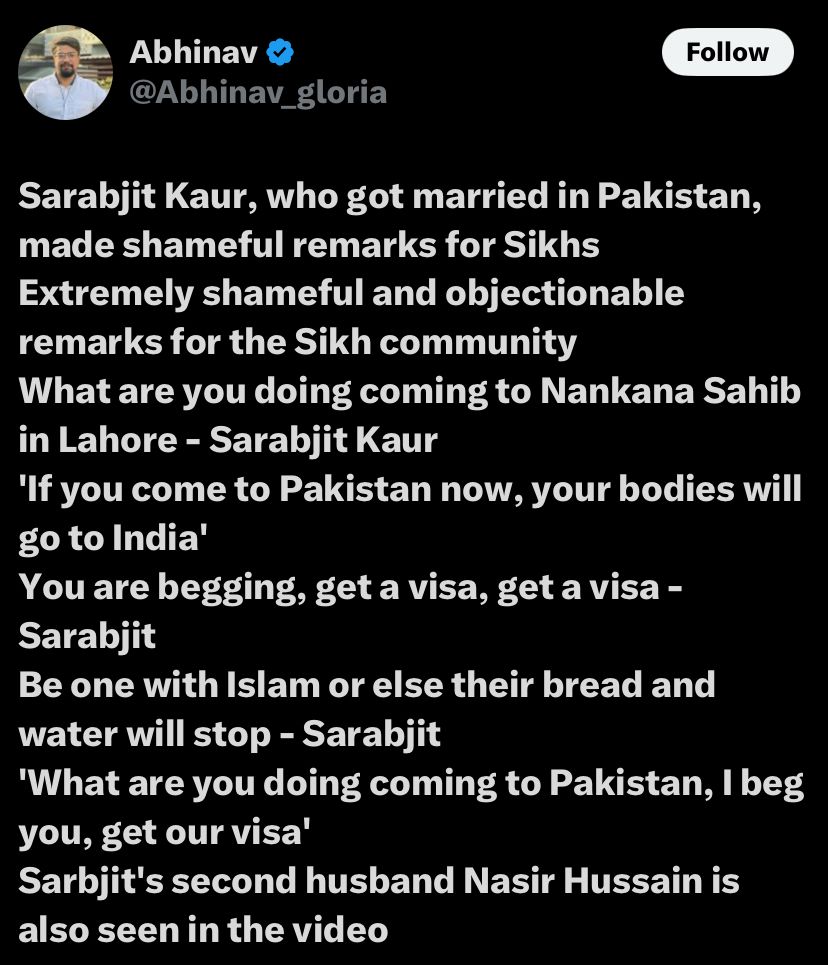
The birth of Guru Nanak Dev, the founder of Sikhism, occurred in 1469 in a small village now known as Nankana Sahib. Today, this site sits within the borders of Pakistan’s Punjab province, making it one of the most sacred yet geographically isolated pillars of the Sikh faith. For the millions of Sikhs living in India and the global diaspora, visiting Nankana Sahib is not a mere vacation but a profound religious obligation. However, recent viral footage involving Punjabi traveler Sarabjit Kaur has ignited a fierce debate that transcends simple tourism. The controversy centers on a fundamental question: Can a site of such immense spiritual gravity ever be separated from the volatile geopolitics of the Indian subcontinent?
The viral video in question featured Kaur expressing sentiments that some interpreted as downplaying the necessity of the pilgrimage or criticizing the conditions surrounding it. While the internet outrage machine churned through its usual cycle of condemnation and defense, it missed the deeper, more uncomfortable reality. Nankana Sahib is currently a focal point for a complex tug-of-war involving religious identity, state-sponsored "religious tourism," and the raw trauma of the 1947 Partition.
The Weight of the Janam Asthan
To understand why a single video could cause such a firestorm, one must understand what Nankana Sahib represents. It is the Janam Asthan, the place of birth. In the Sikh psyche, this is the beginning of everything. When the British drew the Radcliffe Line in 1947, they didn't just divide land; they severed the Sikh community from its heart. Most of the population migrated to India, but their holiest sites remained in a state that was now officially Islamic.
Since then, the daily Ardas (prayer) of millions includes a specific plea for the "open darshan" (unhindered viewing) and management of the gurdwaras left behind in Pakistan. When a prominent figure or influencer visits and makes remarks that seem to challenge the sanctity or the "necessity" of the trip, they aren't just sharing an opinion. They are poking a wound that has been festering for nearly eighty years.
The struggle for access is constant. While the opening of the Kartarpur Corridor in 2019 was hailed as a breakthrough, Nankana Sahib remains deeper inside Pakistan, requiring a visa and a more arduous journey. This physical distance creates a vacuum where misinformation and emotional sensitivity thrive.
The Business of Pilgrimage and the State
Pakistan has realized that its Sikh heritage sites are a goldmine for foreign exchange and international PR. The government has spent millions renovating Nankana Sahib, building hotels, and streamlining the visa process for "Yatris." On the surface, this is a positive development. It preserves history and allows the faithful to return home.
Underneath the shiny new marble, however, lies a more cynical layer. For Islamabad, Nankana Sahib is a tool for soft power. By playing the "gracious host" to the Sikh community, Pakistan attempts to draw a sharp contrast with the political climate in India. This turns every visitor, including Sarabjit Kaur, into an accidental political actor.
When a traveler speaks about their experience at Nankana Sahib, they are navigating a minefield. If they praise the hospitality too much, they are accused of being "pro-Pakistan" or falling for a propaganda trap. If they complain about the restrictions or the state of the facilities, they are accused of disrespecting the holy site or being "anti-Sikh." There is no neutral ground for a Punjabi woman with a camera in Nankana Sahib.
Beyond the Viral Clip
The controversy surrounding Kaur’s remarks often ignores the logistical and social reality of the site. Nankana Sahib is not just a museum; it is a living town. The relationship between the local Muslim population and the visiting Sikh pilgrims is generally one of peaceful coexistence, but it is fragile.
Investigating the "why" behind the visit reveals a split in the community.
- The Traditionalists: View the pilgrimage as an essential act of devotion that must be performed regardless of political tension.
- The Pragmatists: Question the ethics of spending massive amounts of foreign currency in a country with a checkered record on minority rights.
- The New Generation: Often influenced by social media, they seek a connection to their roots but are often unprepared for the heavy-duty political baggage that comes with the territory.
Kaur’s video acted as a lightning rod because it voiced the internal monologue of the Pragmatists in a way that offended the Traditionalists. In the age of instant digital outrage, there is no room for the nuance of a traveler feeling overwhelmed or disillusioned by the reality of a site that has been built up in their mind as a utopia.
The Security Apparatus and the Pilgrim Experience
Anyone who has actually set foot in Nankana Sahib knows the experience is defined by the presence of the Inter-Services Intelligence (ISI) and the local police. Security is stifling. While the state claims this is for the protection of the pilgrims, it creates an atmosphere of surveillance.
You are not just a pilgrim; you are a guest of the state under constant watch. This environment heavily filters what people say on camera. When a video leaks or a live stream captures a moment of "unscripted" honesty, it feels like a breach of a silent contract. The controversy isn't just about what was said; it’s about the fact that it was said at all in a place where every word is weighed for its political utility.
The Erasure of Shared History
One of the most overlooked factors in the Nankana Sahib discourse is the gradual "Sikh-ization" of the site's history, which ironically mirrors the "Islamization" of the surrounding areas. Historically, Nankana Sahib was a place of syncretic worship. It belonged to the Nanakpanthis, the Udasis, and even local Muslims who revered the Guru as a "Pir."
Modern management by the Pakistan Sikh Gurdwara Parbandhak Committee (PSGPC) has focused on a very specific, orthodox version of Sikhism. While this helps in maintaining religious standards, it erases the complex, multi-faith history of the region. When visitors like Kaur engage with the site, they are engaging with a curated version of history. If their personal experience doesn't align with that curation, friction is inevitable.
The Infrastructure of Faith
We must look at the physical reality of Nankana Sahib to understand the frustration that often boils over in these viral moments.
- Transport Hubs: The rail and road links from Lahore are inconsistent.
- The Enclave Effect: Pilgrims are often kept in a "bubble," prevented from interacting freely with the local townspeople.
- The Digital Divide: Internet access is often throttled during high-traffic festival periods (Gurpurab), leading to a buildup of delayed, and often distorted, narratives once people leave the area.
This "bubble" creates a pressure cooker. You have thousands of people in a heightened emotional state, confined to a small area, under heavy security, with limited access to the outside world. This is the perfect breeding ground for misunderstandings that later explode on Twitter or Instagram.
Identity Politics in the Diaspora
The loudest voices in the Sarabjit Kaur controversy weren't even in Pakistan. They were in Southall, Birmingham, Brampton, and California. For the Sikh diaspora, Nankana Sahib is a symbol of a lost kingdom and a spiritual North Star. From the safety of a Western democracy, it is easy to demand a certain level of "performance" from those who visit the site.
The diaspora expects every visitor to act as an ambassador. When someone fails to meet that expectation—by being too critical or not critical enough—they are seen as a traitor to the cause. This puts an impossible burden on the individual traveler.
A Crisis of Authenticity
Is it possible to have an authentic spiritual experience at Nankana Sahib today? The answer is a messy "maybe." The site is beautiful, the history is undeniable, and the feeling of standing where Guru Nanak once stood is, for many, life-changing.
But that experience is being sold. It is being marketed by travel agencies, utilized by the Pakistani government for diplomatic leverage, and used by Indian media to stoke nationalist sentiment. Nankana Sahib has become a stage. The viral video of Sarabjit Kaur was just a moment where the actor forgot their lines, or perhaps decided to speak their own truth in a theater that demands a script.
The controversy isn't a sign that Sikhs shouldn't visit Nankana Sahib. It is a sign that the community is struggling to reconcile its ancient spiritual heart with the modern world's demand for soundbites and political alignment.
If you are planning to go, do not go for the "gram." Do not go to be an ambassador for a government or a political movement. Go to see the dust and the stone, and to understand that the Janam Asthan exists in a place that is as complicated as the history of the Punjab itself. The real tragedy isn't a viral video; it's the fact that eighty years later, the road to Nankana Sahib is still paved with more politics than prayer.
Would you like me to analyze the specific visa requirements and security protocols for international Sikh pilgrims visiting Nankana Sahib in 2026?